

Dear readers, this piece is available to all without a paid subscription. I hope you enjoy it. However, this is a reader-supported newsletter, which means I am reliant on paid subscriptions to keep it going. If you like what you see, and want to see more of it, please consider becoming a paid subscriber today. At just $5 per month, it costs about the same as a cup of coffee. I am deeply grateful to each and every one of my readers for their support and encouragement!
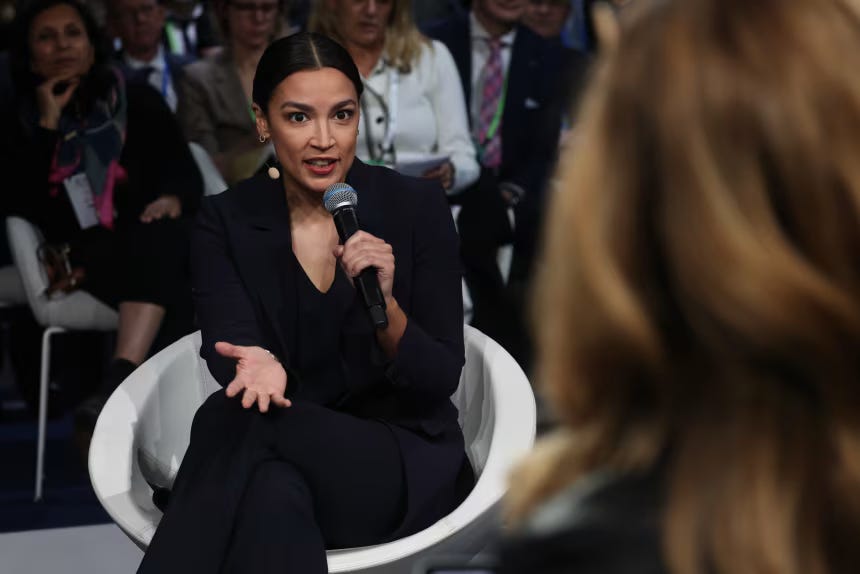
AOC’s big foreign policy debut at the Munich Security Conference last week generated much chatter about a potential 2028 presidential run. It was not that her performance was exceptional exactly, but rather that everyone vaguely left-of-center is desperate for a sliver of optimism from their representative politicians, many of whom have been oddly passive in the face of Trump. To a parched man stumbling through the desert in the noon-day sun, AOC was a shimmering mirage: promising from a distance, but elusive up close.
The Munich Security Conference is attended by the world’s defense and security elite, making it a kind of Davos for decision-makers whose religion is Atlanticism. AOC’s message was perfectly tailored to them: she trotted out the Bidenite “autocracy vs democracy” framework which I spent an entire essay dismantling over at the Ideas Letter last month. By using this framework, AOC communicated to the elite that she belonged at Munich, that she essentially shared their liberal Atlanticist vision of the world, albeit with a few caveats. Among them was her “working class perspective” on US foreign policy. In AOC’s telling, income inequality causes authoritarianism. While I appreciated the novel injection of income inequality into a discussion of democracy and our foreign policy, the point that AOC tried to make was muddled and incoherent. On the one hand, yes, income inequality can lead to polarization, scapegoating, and the rise of right-wing populism. But “authoritarianism” doesn’t quite fit here: you could also argue that left-wing governments have eliminated inequality through authoritarian means. How do you think radical wealth redistribution happens? But I get that what we’re talking about here is an essentially liberal Atlanticist conception of authoritarianism, which means any government that is opposed to the United States and NATO. Still, even AOC appeared to understand that “right-wing populism” was a far better term. At a more confident appearance at TU Berlin later in the week, AOC used “right-wing populism” in the places where she’d used “authoritarian” at the security conference. Here, you could see two slightly different messages for two different audiences: for the security think tank set, who sought reassurance that she would assume the Democrats’ aggressive posture towards America’s enemies, she used “authoritarian”; for left-leaning academics, she used the more precise “right-wing populism”.
Further, AOC’s invocation of the autocracy vs. democracy framework implies that the United States needs to defend democracy abroad. This presumably means shoring up our commitments to NATO (AOC invoked the “trans-Atlantic partnership” more than once) and democracy promotion efforts that take money away from programs that could be used to benefit the American working class. Countries cannot have both a beefed up militarism and robust social welfare: just ask European leaders about the difficult choices they’re making now about their defense. AOC therefore still needs to explain how costly efforts to “uphold democracy” abroad constitute a “foreign policy for the working class”.
In addition, AOC was emphatic that the US needed to “revisit its commitments to foreign aid”: yet another expensive item to add to our sprawling tab! At risk of sounding like a stuffy killjoy, where is the money going to come from to pay for it all? I can already hear the objections: “Lily, we’re going to tax the rich!” Suffice to say, I remain skeptical that this is really possible in the United States, which means that we’re probably just going to end up in the same trap that older, less telegenic Democratic Party leaders have set for us before: bankrolling war and propping up corrupt governments in foreign countries to the detriment of our own abandoned working class, who in turn will be vulnerable to the manipulations of any right-wing populist that comes along.
At another point in her performance at Munich, AOC spoke about American hypocrisy. She described hypocrisies as liabilities. What AOC therefore seemed to gesture at was a newer, better “rules-based order” whereby things are mostly the same as they were before, minus the hypocrisies. The divergent responses to Gaza and Ukraine loomed over this part of the discussion. However, the notion that we can defend democracy abroad without hypocrisy demonstrates a limited understanding of the history of our foreign policy. Indeed, the lions’ share of our hypocrisies have been rooted in our democracy promotion efforts, and have often been framed as a righteous “standing up to authoritarianism”. It has been this belief–that the United States, because it calls itself a democracy, has divine permission to ride roughshod over international law and the sovereignty of other states–that has made our foreign policy hypocritical. AOC’s embrace of Biden’s autocracy vs democracy frame is therefore at odds with her mission to get rid of American hypocrisy.
Many critics have fixated on AOC’s stumbling over a question about Taiwan. In summary, AOC was asked if the United States should defend Taiwan in the event that China were to invade. Of course, Washington’s policy on what to do in such a scenario has long been one of strategic ambiguity: the US will not commit publicly to any specific response to Chinese action on Taiwan. After an agonizing pause filled with lots of fits and starts, AOC eventually eked out a response that hinted at this policy of strategic ambiguity, but it came across as amateurish. Predictably, the response to pointing this out was ad hominem attacks mixed with delusional wishful thinking. “I bet you couldn’t answer that question!”, “Rubio and Vance could never come up with an answer that good!”, “what about Trump’s gaffes?” I fear that this represents a dangerous level of complacency. At this point, everyone should know that this is how the social media ecosystem operates and therefore be able to anticipate attacks rather than complain about how unfair they are after the fact. The best way to prepare is to work to patch up vulnerabilities, not attack anyone who points out self-evident weaknesses that any voter would pick up on. And yes, presentation matters. Voters want to feel reassured that their elected officials can take decisive action when necessary, and that they are confident and well-prepared. Trump’s deviation from the norm does not absolve Democrats of this.
But even a rotten-hearted cynic like me must concede that it wasn’t all bad. At a talk at TU Berlin later in the week, AOC appeared stronger and more self-assured. She cautioned against the temptation of political cynicism, sharing her own story of overcoming it. Here, her millennial relatibility was an asset rather than an embarrassment: she let her story speak for itself. She also warned about the dangers of atomization, of a world in which we call an Uber to take us to the airport rather than get a ride from friends, and where the bonds of community and family are dissolved to make way for the market. Here I could see flashes of AOC at her best: not as an extremist firebrand, as the right so often depicts her, but as a consensus-seeking bridge builder. It’s a perception that has made her the most popular candidate for 2028 among Democrats under 30 by far: 30% of Democrats between 18-22 and 35% of Democrats between 23-29 say they would vote for her if the presidential primary were held today. But despite this formidable position she’s earned in the party, her lackluster trip to Germany suggests that it’s not nearly enough.
Strong analysis and well-written too.