

This post is free to all readers. If you would like to access more of my work, consider becoming a paid subscriber today–it costs about the same amount as a pumpkin spice latte.
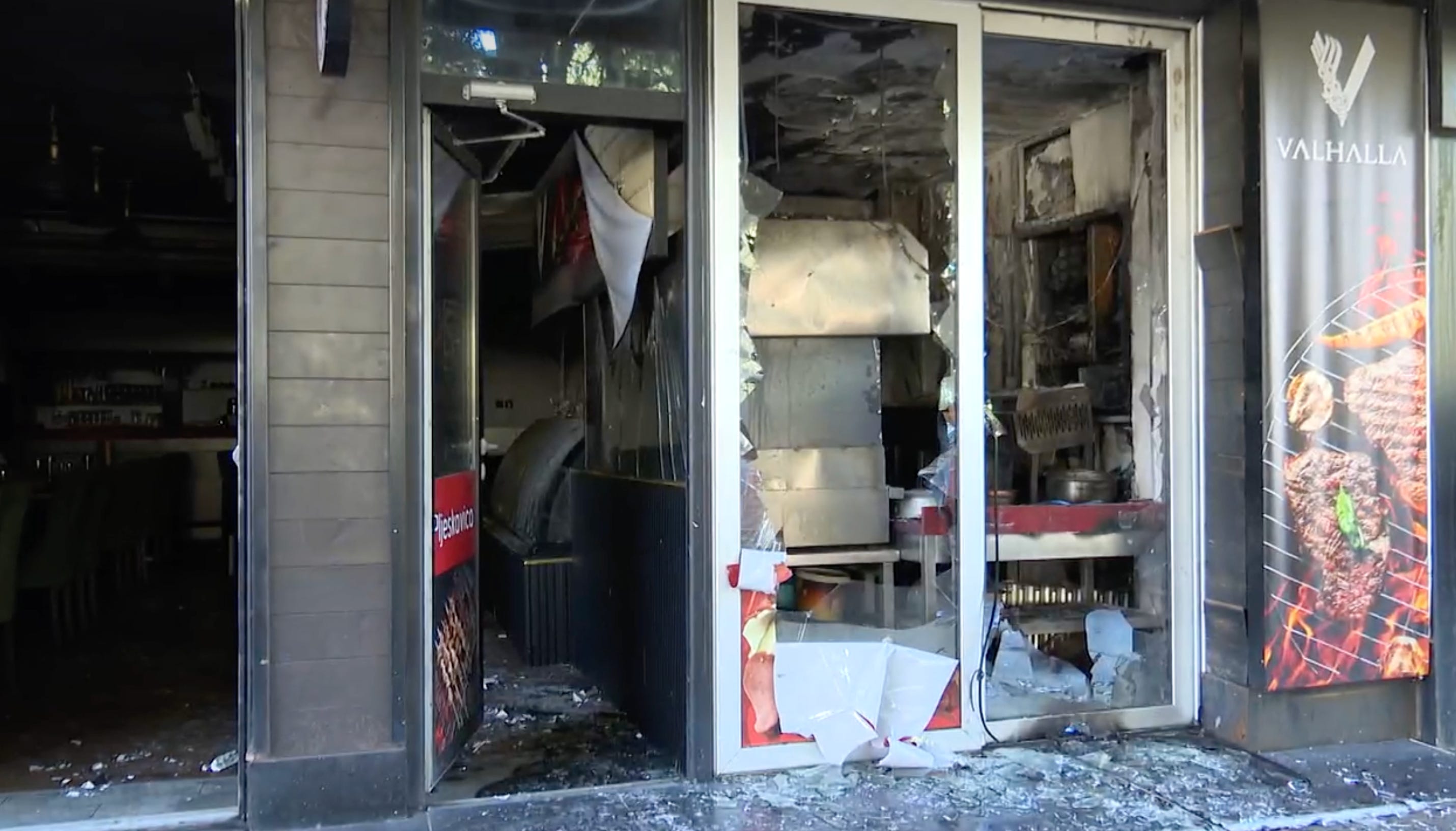
Over the weekend, a Montenegrin man was stabbed by a group of Turkish citizens in the dull provincial capital of Podgorica in Montenegro. The man was allegedly attacked because he had confronted the Turkish group over their harassment of a woman in a nightclub. Though the Montenegrin’s injuries were not life-threatening, the incident triggered a spasm of retaliatory attacks on Turkish property, revealing an undercurrent of ethnic tension that rarely surfaces but has been intensifying as of late. Several cars with Turkish license plates were vandalized, while a Turkish restaurant had its windows smashed in before being broken into and set on fire. A number of Turks also reportedly barricaded themselves inside a casino as a crowd outside shouted “Ubij Turčina” (kill the Turk, a slogan with a dark history in the Balkans; it has occasionally been been paired with nož, žica, Srebrenica–”knife, wire, Srebrenica”).
A Turkish national and a citizen of Azerbaijan were reportedly detained in connection with the non-fatal stabbing. An astonishing 45 additional Turkish and Azerbaijani citizens were also arrested on suspicion that they lacked the required legal residency documents to live in Montenegro. Seven of those detained in the round-up received fines, while eight others were issued deportation orders. Equally extraordinary, Montenegro’s millennial crypto bro Prime Minister Milojko Spajić announced on X that his country was suspending visa-free travel for Turkish citizens. Interior Minister Danilo Šaranović also said that a new “law on foreigners” would be on this week’s parliamentary agenda and would be “far more restrictive” than the one currently on the books. Taken together, the official response to the incident was therefore one of sweeping collective punishment.
Keeping with Balkan tradition, Montenegrin politicians fanned the flames of ethnically-motivated discontent with wildly irresponsible statements in media. In a television interview over the weekend, Milan Knežević, a prominent politician and founder of the right-wing pro-Serbian Democratic People’s Party, made the absurd claim that there were 110,000 Turkish citizens living in Montenegro. The population of the entire country of Montenegro is just 600,000; in reality, only about 14,000 Turkish nationals live in the tiny country. But with this distorted figure, Knežević tapped into existing resentments: in recent years, Turks have looked for ways to establish residency in Montenegro as they believe–rather optimistically, I should say–that the country is on the precipice of EU membership. Some Turks have therefore established businesses, the easiest way to obtain Montenegrin residency; wealthier Turks have purchased property. These are exactly the kinds of “loopholes” that the EU will want Montenegro to close long before the country is ever admitted to the bloc. This unfortunate incident will therefore have been quite useful for the Montenegrin government, which probably wanted to tighten up immigration from Turkey anyway.
Knežević also said that Erdogan was building a munitions factory in Kosovo, and made several accusations about the Turkish leader’s purported plans for the Balkans. This was significant: as some of my readers may remember, Turkey-Serbia relations fell to their lowest point since Serbian President Aleksandar Vučić came to power earlier this month, after Ankara delivered a bevy of Turkish-made drones to Kosovo (I wrote about it in detail here). Vučić accused Erdogan of wanting to resurrect the Ottoman Empire, a striking charge considering their relations had been amicable for the past decade. Knežević is a pro-Belgrade politician with intimate ties to Serbia, and in his statements about Erdogan, you see how in lockstep he is with Vučić. Twice Knežević repeats a fake Erdogan quote that made the rounds in Serbia and Bosnia in 2014. Though widely and repeatedly debunked as fake, Knežević claims that Erdogan warned that he would bring “100 million Turks” to fight the Serbs if they ever “touched the Bosniaks”. Another population fact check is needed here: the entire country of Turkey has a population of 85 million. But what is most significant here is the resurrection of stale anti-Turkish rhetoric, a staple of Serbian nationalist discourse for centuries, kept dormant during the so-called “golden age of Serbia-Turkey relations” but now dusted off and employed once again at a time of political crisis for Vučić and his allies in the region.
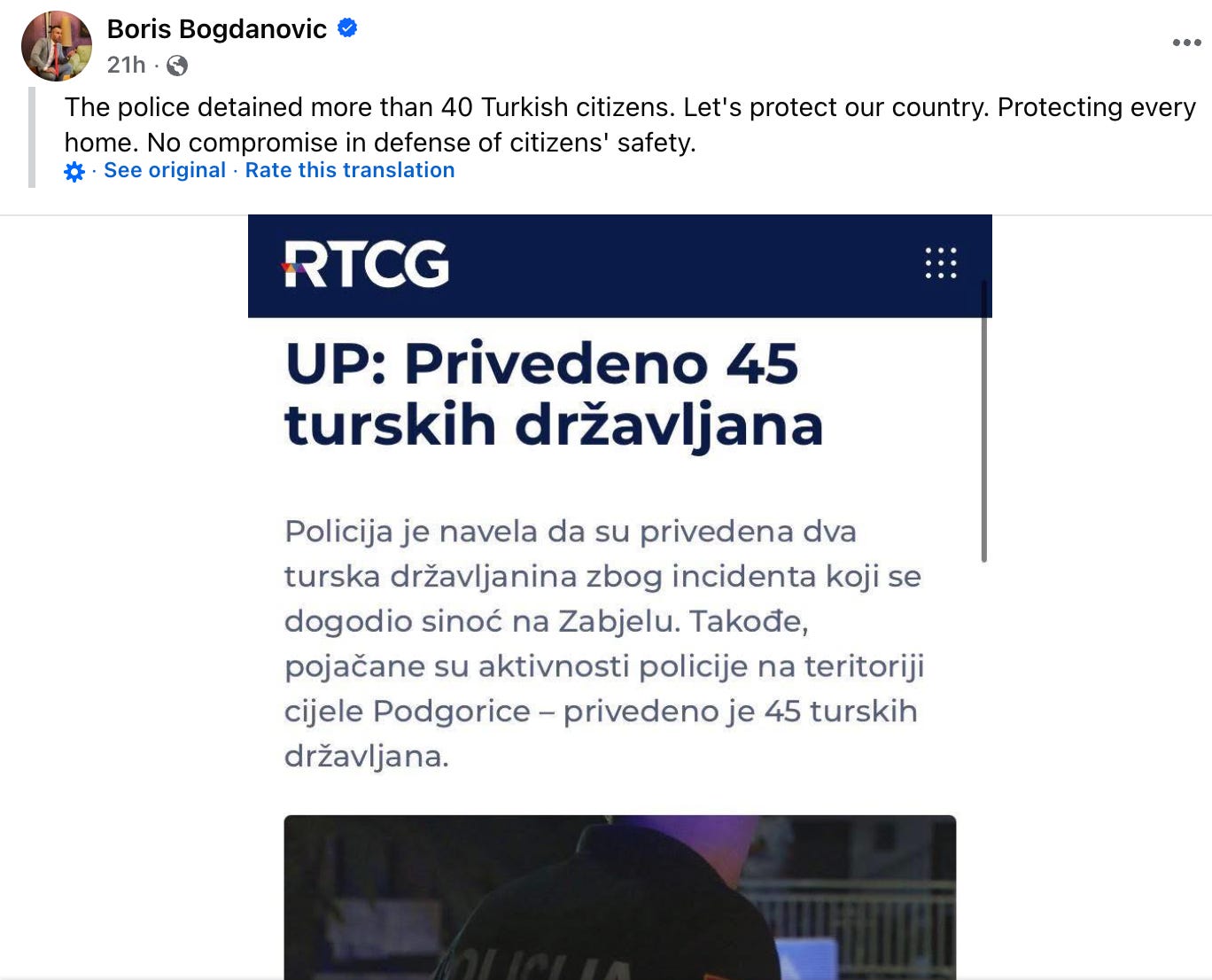
Other Montenegrin politicians did their part to make things worse. Boris Bogdanović, an MP from Interior Minister Šaranović’s Democratic Montenegro, posted a particularly tasteless image and comment to social media over the weekend: along with news of the detention of 45 Turkish citizens, he wrote “protecting every home. No compromise in defense of citizens’ safety.”
Ordinary people in the region were also quick to demand a harsh, collective punishment for a non-fatal knife attack outside of a club, after an argument over a girl. My own mentions on X were filled with calls to “impale Turks” and collages of headlines about purported Turkish crimes committed in Montenegro. Of concern to some was that further anti-Turkish sentiment could also lead to attacks on other Balkan Muslims, particularly Albanians and Bosniaks, both of whom are minorities in Montenegro. Of course, that is worst case scenario, and we are not near that yet, but the cocktail of heightened geopolitical tension, sudden acts of violence, intensifying ethno-nationalist rhetoric, and irresponsible politicians with large media platforms does warrant elevated concern.
Absolutely horrific and maddening tragedy all-round. I hope this vile and dangerous anti-Turk sentiment doesn't spread elsewhere in the WB. I have several Turkish friends in Serbia who, while typically feeling welcome and safe, always have a mental backpack prepared in case something precisely like this happens. A few years back I met some delightful Turkish tourists in Bosnia and we ended up travelling around the country together for a week or so. They mentioned having experienced antipathy in Montenegro, to the extent some restaurants/bars wouldn't accept their custom. You're entirely right, the situation does warrant elevated concern.