

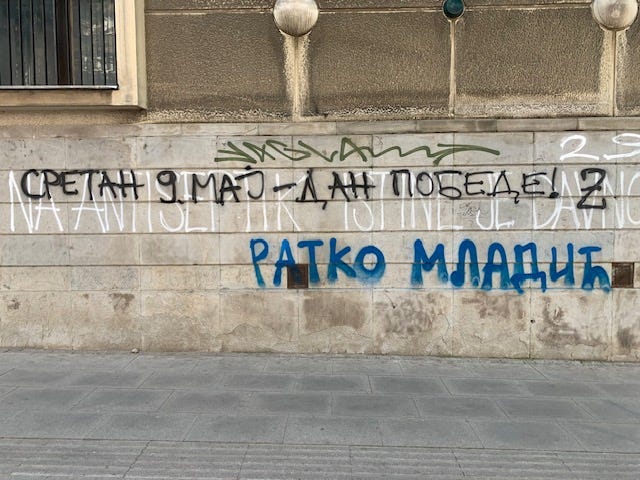
Dear readers, the second half of this post is behind a paywall. If you have the means and would like to support my work, consider becoming a paying subscriber today. It’s only $5. I am extremely grateful to each and every one of my subscribers for their encouragement and support, without whom I wouldn’t be able to do this.
I was in Serbia the day they caught Mladić. I remember exactly where I was when I heard the news. I was sitting at the kitchen table in my Serbian ex’s small apartment off Skadarlija. We were jubilant. I was living in London then and visiting Belgrade for just a few days, and I was excited to experience history firsthand. But our happiness was tempered by the knowledge that it had been too long. Mladić had been in hiding for 16 years. The chances that the Serbian government hadn’t known where he was were next to nothing. In other words, the Serbian state had almost certainly been protecting him. The International Criminal Tribunal for the former Yugoslavia (ICTY)–a spiritual progenitor to today’s beleaguered International Criminal Court (ICC)–had issued an international arrest warrant for Mladić in 1996. He was finally captured on May 26, 2011.
Sometime later that afternoon, we walked to Trg Republike, to the statue of Knez Mihailo on a horse. We assumed–or perhaps we had been told, I can’t remember–that there would be some kind of a protest there, and we wanted to see it. But as we approached the square, we were surprised to see that there weren’t many protesters gathered. My ex later noted this on his blog, writing that the size of the pro-Mladić protest wasn’t much bigger than a protest held in support of Gaddafi there a few weeks earlier. (May of 2011 was the height of the Arab Spring, and NATO had taken over military operations in Libya at the end of March). The New York Times picked up the reporting on his blog along with the video he’d taken of the protest, and published both on The Lede. That night, we drank a bottle of Vranac at a fish restaurant in New Belgrade to celebrate the day’s events. It all felt dizzying and exhilarating, like the future was still malleable.
It was easy to understand the international interest. It was a remarkable thing: nationalism, at last, looked like it might be in retreat in Serbia. A few weeks later, the New York Times ran a full piece titled “Nationalism Fading from Serbia’s Political Stage”. According to its author, the “once-fiery Serbian nationalism now seems strangely muted”:
With the 68-year-old General Ratko Mladić settling into his prison cell in The Hague, the relative silence with which Serbs greeted his arrest and extradition speaks volumes about the turnaround taken by the country’s leadership and the fading of nationalism as an issue from the political stage.
If it weren’t for the subject’s seriousness, you might be forgiven for laughing. (However, I should emphasize that I am absolutely not criticizing the writer of this piece.) The article continues:
The nationalism associated with Serbia — anti-Western, chauvinist, homophobic and violent — still exists among the same small portion of the population but now with one important difference.
“The political elite is not provoking it,” Mr. Bogosavljević [director at pollster Ipsos Strategic Marketing] said.
And now you could cry. Of course, the Serbian political elite does little else in public life besides stoke nationalism today.
Since Mladić died two weeks ago, I’ve been thinking a lot about that brief, optimistic moment in time. Yesterday, Mladić was given a hero’s funeral in Belgrade. President Vučić’s son Danilo was there, as was Serbia’s Defence Minister Bratislav Gašić and the Minister of Justice Nenad Vujić. The funeral was led by the Patriarch of the Serbian Orthodox Church. While much of Serbian society is more apathetic than enthusiastic about Mladić, there’s no question as to what the political elite thinks.
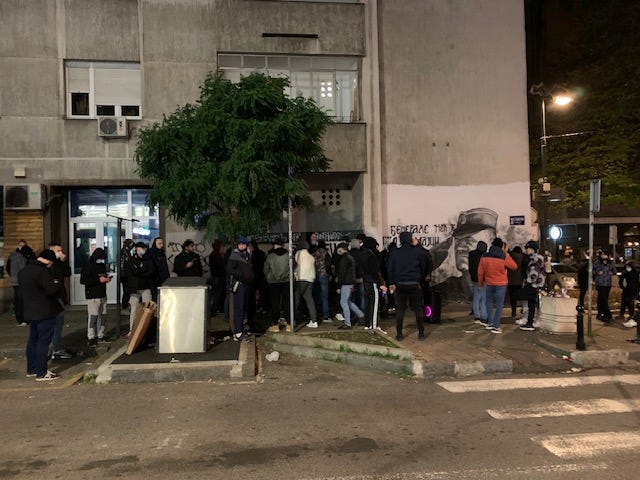
In the lead up to this appalling spectacle, I have been asking myself: could it have been different? What could have and should have happened then that didn’t? The question took on an even heavier quality on Sunday, when the far-right AfD won the election in Germany’s eastern state of Saxony-Anhalt by a landslide. For a lot of people, Germany is the gold standard for what Adorno called “coming to terms with the past”. Serbia’s neighbors have often lamented that Serbia did not follow Germany in its forging of a memory culture and contrition for war crimes and crimes against humanity. But the massive victory of the AfD indicates that Germany has not vanquished its far-right after all; perhaps it was laying dormant all along. Of course, there are important differences between the AfD and the Nazi Party: the AfD does not appear interested in rapacious eastward expansion, for one. That'’s different, and it would be hysterical to suggest otherwise. But the party’s rise still begs discomfiting questions about German society.