

I got a lot of new subscribers last week, briefly sending me to #19 rising in Global Affairs (thank you all very much!), so I thought I’d re-introduce myself. I’m Lily Lynch, a foreign affairs writer currently based in Istanbul, formerly Belgrade, and originally from California. This newsletter is about the entire world albeit observed from Europe’s southeastern flank (the Greater Balkans) perennially on “the EU’s doorstep”. I’m the co-founder and editor-in-chief of Balkanist Magazine, and you can find my writing in places like New Left Review, the New Statesman, UnHerd, the Baffler, and others. I have recently started adding video interviews here, so consider subscribing today if you don’t want to miss anything.
This is a bi-monthly feature wherein I tell you what I’m reading, watching, and otherwise consuming. The first part is free; the second part is for paid subscribers only. This week, I watched an enemy propaganda film that is supposedly being suppressed in America, read an article and a book on HTS–the group that seized power in Syria a year ago this week, and reviewed Trump’s new National Security Strategy.
Enemy Propaganda
I love consuming enemy propaganda, and for that reason, I recently decided to watch The Anniversary (2025), a new movie by Polish director Jan Komasa that promised to be a great artifact of enlightened centrism in the age of Trump. The premise of the film is actually a pretty great one: it’s about the rise of a cult-y authoritarian movement in America, but in miniature, told through the experience of a single family. I was primed to find the film ridiculous but fun, a bit of overwrought, self-aggrandizing liberal agitprop like Handmaid’s Tale, and it was… sort of. The film’s creators are now claiming that Lionsgate is intentionally suppressing it so as not to risk incurring the wrath of the Trump administration. “The film was buried because it is incendiary,” said Frank Wuliger, a partner at the Beverly Hills-based Gersh talent agency who represents Komasa and helped get the movie made. I thought of Edward Luce’s recent FT piece about people supposedly being scared to go on record these days for fear of Trumpian reprisals. With this in mind, the film I had intended to watch as a piece of trashy political entertainment took on a slightly more serious tone. But only slightly.
The Anniversary’s plot is as follows: Over a five-year period, we follow the steady destruction of a large, telegenic family in the upper middle class suburbs of Washington DC. The film opens at the 30th wedding anniversary celebration of a married couple–the wife, Ellen, is a famous political science professor at Georgetown and her husband Paul is a successful DC restaurateur. They have three daughters: a popular lesbian comedian (Anna), an environmental lawyer (Cynthia) with an African-American husband (Rob), and their youngest, a budding microbiologist who still lives at home and grows viruses in a DIY lab in her bedroom (Birdie). The couple also has a son, Josh, a moppy-haired failed writer in hipster glasses (circa 2009), who clearly resents his sisters’ success. But he’s no incel. In fact, the drama begins when Josh brings his new pretty girlfriend, Liz, around to his parents’ anniversary party. From our first glimpse of Liz, we know she’s different. In the affluent blue state milieu, she looks out of place. She is prim and wears a pastel 1950s-style dress, and is therefore vaguely trad-coded. When she introduces herself to her boyfriend’s parents, we learn that she is from a broken home somewhere in the midwest. She is clearly brimming with ressentiment towards her boyfriend’s rich, liberal family, but the truth, we soon discover, is so much worse than that: Liz was once a student in Ellen’s class at Georgetown! And she was expelled for “anti-democratic” ideas!
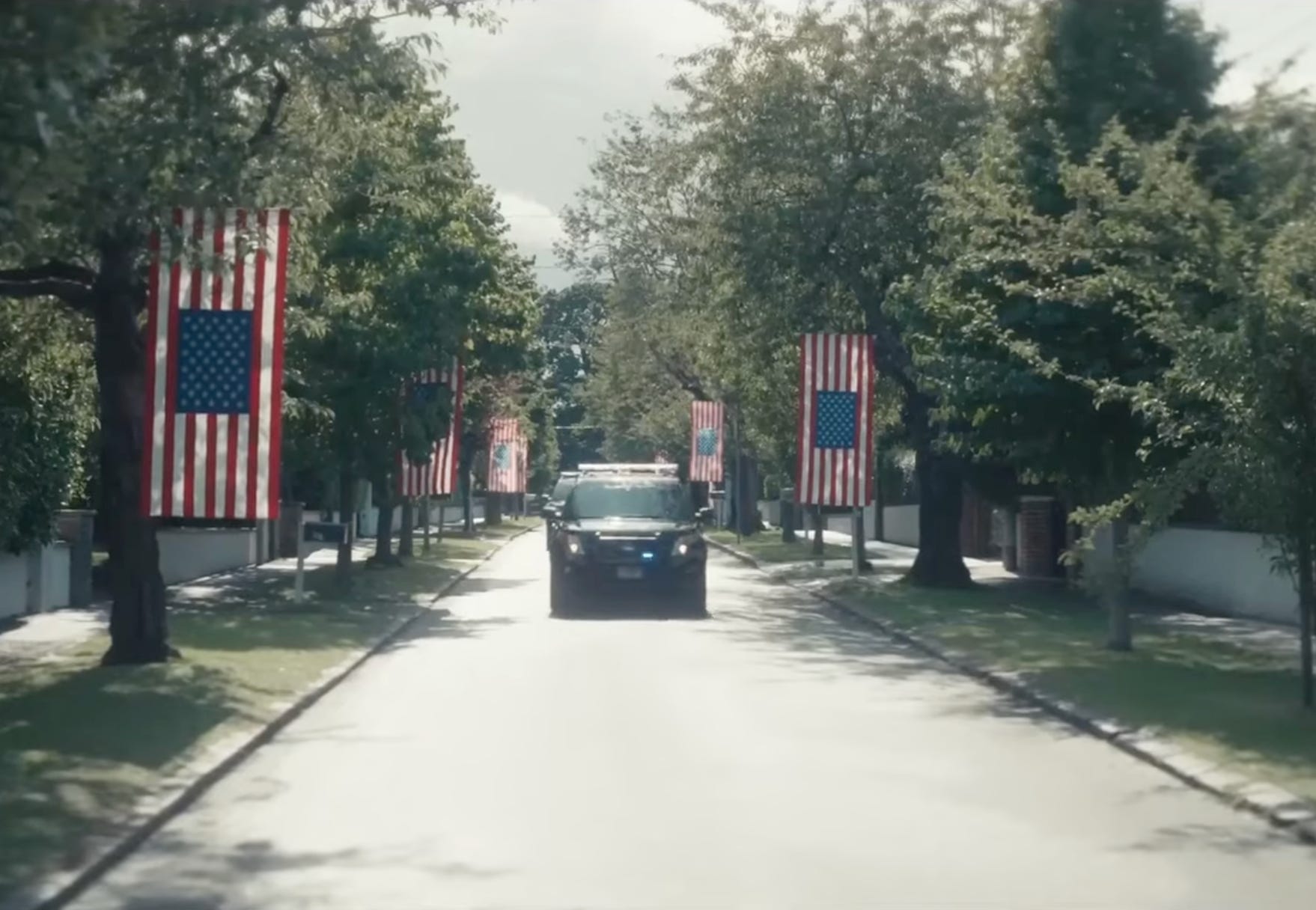
Liz writes a book called The Change which advocates for a one-party system to unite the country; it becomes massively successful and pretty soon, people are hanging a redesigned American flag (the stars are in the center now) in front of their homes. The Change tears America apart, dividing people into us and them: pretty soon a curfew is imposed and surveillance drones buzz around issuing terrifying warnings to shellshocked suburbanites. Josh’s Hitlerian character arc is the most gripping to watch (the acting is fantastic), transforming as he does from a downwardly mobile failed writer into a loathsome power-tripping fascist. The funniest part of the film is when Maddie brings her antifa boyfriend to some kind of family event and Josh interrogates him about what he’s planning to study at college. “Journalism,” the antifa boyfriend answers. It’s a hilarious record-scratch moment: just the word “journalism” is enough to ratchet up the dinner table tension and make beads of sweat start forming on Josh’s forehead. I abhor this liberal veneration of the journalist as a “guardian of democracy”. There are heroes among us but there are plenty of sons of bitches too. I also can’t help but notice that the elevation of the role of journalist to some kind of protected class has happened in tandem with the profession growing more elite: not that long ago, journalism was a job for the working and lower middle classes. Now it is a job for the upper middle class; of course the privileged expect coddling.
The Anniversary is alternately funny and depressing. I could go on about how it functions as propaganda: dinner-party liberalism is depicted as pathology-free, natural. Rich liberals are rich because they are good. Much has been made about the film’s lack of political commitments; “The Change” is faintly right-wing coded but just barely, and it’s not identitarian. It is only “anti-democratic”–the ideal foil for State Department ideology. I saw an interview with Komasa in which he insisted that the “neither left nor right” character of The Change was intentional, and rooted in the 20th century experiences of his native Poland. “We’ve had every kind of -ism” he said. In the end, I wasn’t sure how to feel about this film. As the Anniversary’s producer Nick Wechsler recently told the Wrap, “It’s hard to market a political film today. People are afraid of them – they don’t know how it will be received emotionally. It’s a weird time.”