

Dear readers, these are precarious times for journalists, so do consider becoming a paid subscriber today. It costs about the same as if you bought me a coffee drink once per month. I am back from my trip to America so will be getting back on a regular posting schedule now. The first part of this post is free to all; the second part is behind a paywall. I am deeply grateful for the support of each and every one of you.
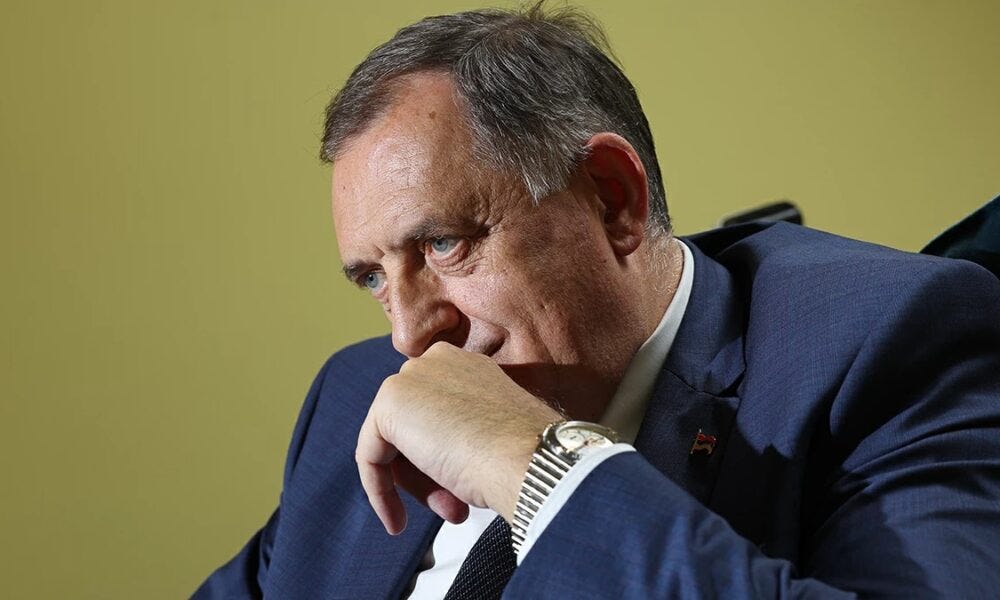
“Republika Srpska is the Israel of the Balkans,” former Bosnian Serb president Milorad Dodik told the Jerusalem Post in a sit-down interview this week. So confident was he in this point that he repeated it more than once. Dodik was in Israel to receive an award named after Ze-ev Jabotinsky, leader of the Zionist Revisionist movement that nursed ties with European fascists and established a naval academy in Italy in agreement with Mussolini. Jabotinsky’s right-wing Revisionists advocated for Greater Israel territorial maximalism, making him Dodik’s ideological kin. In his interview with the Jerusalem Post, Dodik expressed his admiration for Jabotinsky and emphasized the many parallels he saw between Republika Srpska and Israel, along with the Serbian and Jewish peoples’ struggle for survival and for a state. “If we don’t have our own country, we won’t survive,” he asserted, an implicit reference to Republika Srpska’s secession from Bosnia and Herzegovina, something Dodik has been talking about for years.
At first glance, this would appear to be more of the same. In addition to raising the spectre of secession, Dodik has regularly defied Bosnia’s High Representative, the Raj-like colonial administrator of post-war Bosnia, currently a German. He has long said the Dayton Accords–the peace agreement that ended the Bosnian War in 1995–were being “dismantled” by Sarajevo. And for decades, he has cultivated deep ties with Israel, something that has too often been ignored by Western media. But watching Dodik in this interview with Israeli media, I felt my stomach drop. Dodik wasn’t just reciting his usual litany of complaints; he looked sharper and more focused. His intent was different and he had a confidence I hadn’t seen before. This time, it occurred to me that he was also soliciting Israel’s support for Republika Srpska’s secession. A few months ago, I would have brushed the idea off as the stuff of pure fantasy. But Dodik has navigated the Trump era with unexpected success, even managing to get US sanctions imposed on him and his associates lifted in October. Compounding my dread was Israel’s recent rogue diplomatic activity. In December, Israel recognized Somaliland–a breakaway region of Somalia–as an independent state. While Somaliland has strategic value to Israel that Republika Srpska does not, the statehood recognition demonstrates that Israel is willing to break with convention and set new precedents; indeed, Israel was the first and remains the only country in the world to recognize Somaliland as an independent state. Was it possible that Dodik would convince Israel, or some other friendly country, to “recognize” Republika Srpska in the same way? Surely the idea is very farfetched, but then we are in unchartered territory. There was also the matter of increasing tensions between Israel and Turkey, and the potential for them to play out in the Balkans: the Turkish government had facilitated several recognitions of Kosovo’s independence this past year (I wrote about it here), which made me wonder if Israel would back its own statehood project? Once again, the threat is remote, but Israel has also been eager to promote itself as a defender of Christian interests, both to deflect from its own appalling treatment of Christians and to maintain the support of the powerful Christian Zionist contingent in the US; aligning with embattled Serbdom could correspond with this goal. In chaotic, Trumpian times, what was once regarded as impossible now seems possible.
Even if Dodik is not successful in garnering international support for Republika Srpska’s secession–and I still think it’s unlikely that he will–the normalization of the once-radioactive Dodik is significant on its own. I underestimated him before and I will be careful not to do so again. When Trump began his second term, Dodik was still under US sanctions imposed by the outgoing Obama administration in 2017. Dodik and his associates in Republika Srpska were sanctioned for “undermining the Dayton Accords”–in short, secessionist activity. Dodik had pinned all his hopes for the lifting of those sanctions on Trump getting a second term, but I believed then that those hopes would amount to nothing. I assumed that Dodik was too odious a figure even for Trump. But Dodik, against the odds, made major inroads with MAGA, including figures like Laura Loomer, who has spoken of Dodik as if he was some kind of Christian martyr, as well as Trump’s former national security advisor Michael Flynn and former governor of Illinois Rod Blagojevich. With this backing, Dodik managed to have US sanctions lifted on himself and all of his associates. As part of that deal with the US, Dodik agreed to resign from office, but he remains an outsized presence in Republika Srpska’s public life.
Watching his Jerusalem Post interview, I started to understand how Dodik has managed the Trump administration and Israel so well. He hit all the right notes. He spoke of “mass migration” in the West, where Muslim newcomers had “brought their faith” and supposed antisemitism with them. He railed against the “demonization” of Israel and Republika Srpska by “liberal elites”, and he decried the alleged antisemitism of Sarajevo, “the most prominent Muslim city in the Balkans”. He said that the UN was opposed to Israel and Republika Srpska, and that “the normal rules stop being enforced or applied in the case of Israel… it’s the same principle applied with Srpska.” The message Dodik was sending was clear: do you see now? They lied about us in the 1990s, and now they are lying about you too. They called us genocidal in the 1990s and now they are calling you genocidal. There is no “international law”; the courts in The Hague are kangaroo courts. We perished together in the fascist concentration camps during WWII, and we must stick together today or perish again. At every turn, Dodik told the Israelis and their American supporters what they wanted to hear, reflecting back to them a vision of reality that was both legible and flattering.
Before departing for Israel, Dodik stated that “nothing would be the same” for Republika Srpska after his trip. By all accounts, he appears to have been pleased by the visit. In an interview with Radio Television Republika Srpska, he said that “the highest officials of Israel are convinced that the Dayton Agreement no longer exists, that the position of [Republika Srpska] must be redefined in the international sense.” He described his meeting with Benjamin Netanyahu as one of the best he’d had in years. In a series of posts on social media, Dodik spoke of the right of Republika Srpska to self-determination; Blagojevich commented on X that said right was “a matter of great importance for stability in Europe and the preservation of the right to freedom of worship for Christians and Jews.” General Flynn concurred, writing that both Dayton and the NATO Charter needed to be “reexamined”. While these individuals are not exactly MAGA’s inner circle, it’s clear that Dodik’s message is gaining some sympathy in Washington.