

This post is free and open to all, but this is a reader-supported newsletter. If you like what you see, and want to see more of it, consider becoming a paid subscriber today. Much more is coming in the next few weeks.
Aleksandar Vučić is slipping deeper into international isolation. In October, I wrote that his “balancing act” had collapsed. For years, Vučić had assumed a kind of quasi-neutrality with respect to the United States, EU, Russia, and China. Since his party came to power in 2012, he had successfully maintained good relations with both East and West, drawing criticism from some State Department officials who accused him of “sitting on two chairs”. But since the beginning of Trump’s second term, the old act has ceased to work. Now the walls are closing in with accelerating speed.
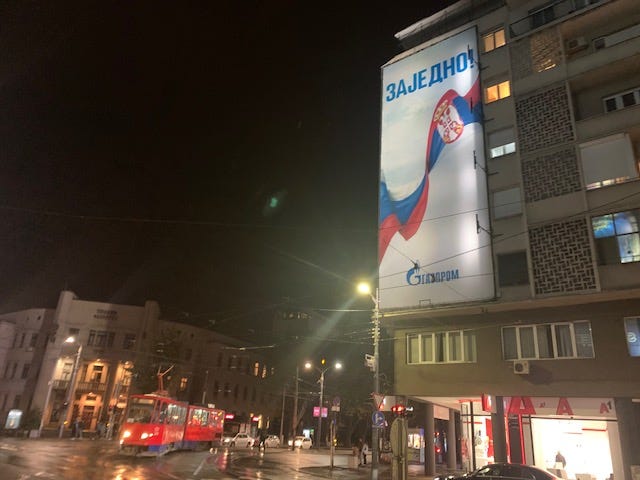
Earlier this month, Serbia’s only oil refinery, located in the city of Pančevo near the capital of Belgrade, ground to a halt. The Petroleum Industry of Serbia (NIS) refinery in Pančevo supplies 80 percent of the country’s fuel but shut down after burning through its last reserves of oil. NIS is majority-Russian owned and thus came under US sanctions earlier this year; despite desperate Serbian government efforts, Washington refused to issue the refinery an operating license. It’s difficult to overstate the seriousness of this mess for Vučić. NIS is one of Serbia’s largest employers, with a staff of around 14,000 people. The oil company contributes around 5% of Serbia’s GDP and 10% of its budget revenue. Livelihoods are now in jeopardy. Continuing payments also risks exposing Serbia’s central bank to secondary sanctions, which Vučić said would amount to the “complete destruction of the Serbian financial system”.
Just yesterday, the United States also enacted the National Defense Authorization Act (NDAA) which includes the Western Balkans Democracy and Prosperity Act. The latter includes scathing criticism of Serbia, singling the country out for its irregular elections and communicating “deep concern” regarding its “state of democracy”. Indeed, Serbia is the only country of the so-called Western Balkans–Albania, Bosnia, Kosovo, North Macedonia, Montenegro, and Serbia–that is mentioned in this way. The act draws special attention to the contested December 2023 parliamentary elections, which I wrote about for New Left Review’s Sidecar. The Western Balkans Democracy and Prosperity Act chastises the Vučić government for accusing civil society, the opposition, and protesters of “trying to destabilize Serbia”, emphasizing that doing so “threatens the safety of important segments of Serbian society.” Elsewhere in the act Serbia is not mentioned explicitly but it is clear they’re talking about Serbia. The act notes that “corruption and disinformation spread in political environments marked by autocratic control or partisan conflicts.” There is but one country among the West Balkan six that is regularly described as “autocratic”. However, what is most significant about the act is that it gives the US president the authority to impose sanctions on any individual engaged in corruption in the Western Balkans, including “corruption by or on behalf of a government in the Western Balkans, or a current or former state official in the Western Balkans.” Said sanctions must be imposed within 90 days of the adoption of the act, which Trump signed yesterday. This means that Vučić and his associates will be sweating bullets in the weeks and months ahead.
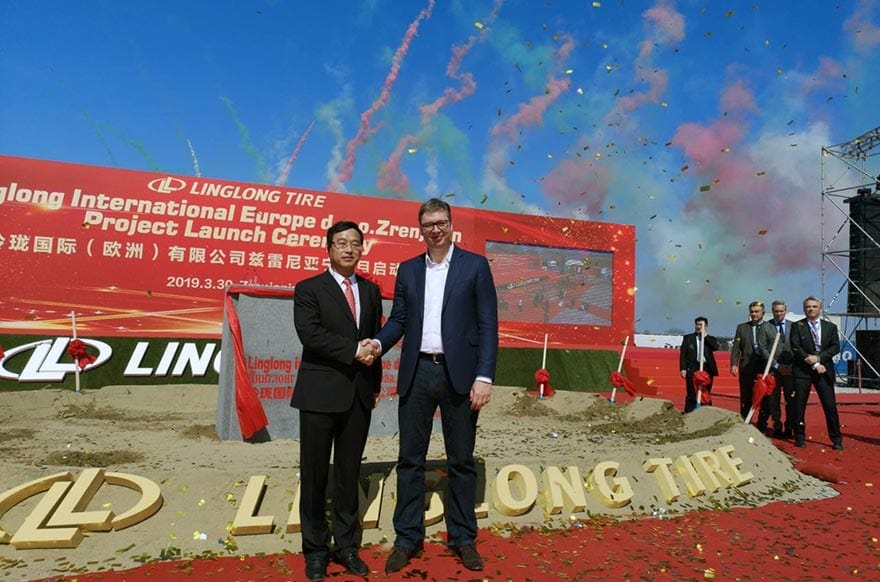
That wasn’t all. Last night, US Customs and Border Protection issued a “withhold and release order” against tires made in Serbia by Linglong International in Zrenjanin, a controversial Chinese manufacturer, over “evidence reasonably indicating the use of forced labor in their production.” Allegations of labor exploitation of Vietnamese and Indian workers at the Linglong plant have been lodged for years, dating back to its construction. The European Parliament called on Serbia to address its “modern slavery” problem in 2021, but nothing happened. Last night’s order constitutes another blow to Vučić, who often boasted that the Linglong factory in Zrenjanin was “the biggest greenfield investment in Serbia’s history”. The facility is the first Chinese tire producer in Europe and was trumpeted by both the Serbian and Chinese governments as integral to the two countries’ “steel friendship”. Vučić also treated the Linglong factory as a personal achievement, and Washington’s ban on imports from the manufacturer now casts a dark shadow over it.
While the US has taken the more aggressive approach to the Vučić government as of late, the EU-Serbia relationship is also badly strained. This week, Vučić announced that no representative from Serbia would attend the EU-Western Balkans summit for the first time since the country gained candidate status in 2012. The evident boycott was decided on after a frustrating dinner in Brussels with European Commission President Ursula von der Leyen, wherein Vučić reportedly proposed that all six Western Balkans countries join the European Union together. Von der Leyen and other European officials rejected the idea; instead, neighboring Montenegro successfully closed five chapters this week and now looks to be the “frontrunner” for EU membership–a mantle once held by Serbia. While any real EU accession is still far off, and may well not happen at all, the fact that Serbia’s candidacy has now been stalled for almost half a decade while the neighbors proceed does not look good for Vučić. Adding insult to injury, it was also announced that EU sanctions on Kosovo would be lifted. This move signaled a continuation of diplomatic momentum shifting in Kosovo’s favor, something evident in the three new recognitions of Kosovo’s statehood that have come this year.
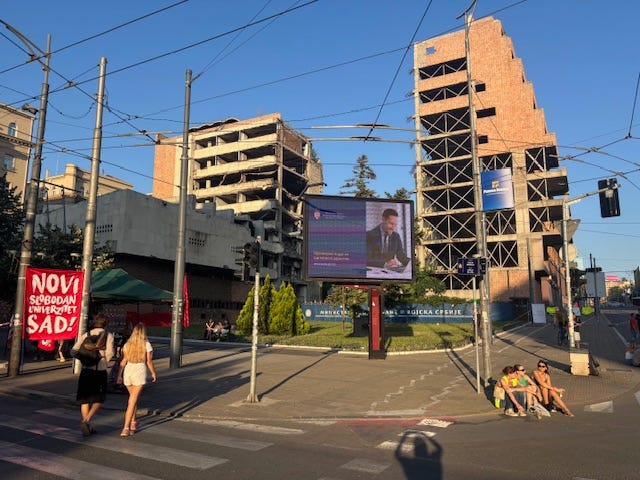
And yet, even after all these devastating wounds, Vučić still had one card left to play: Generalštab. The old Yugoslav Defense Ministry building, in ruins since being hit by NATO airstrikes in 1999, was to be Vučić’s last tool for salvaging relations with the Trump administration. An appropriately Trumpian plan was hatched to do it. Jared Kushner would develop the site, building luxury apartments, a hotel and casino atop the old ruins. This was to be Vučić’s golden ticket to warm relations with Trump, and his government pulled out all the stops to secure it, including steamrolling parliament and bending laws to their breaking point. But the people of Belgrade would not let it pass. After intense public backlash and protest, along with indictments filed by the Prosecutor’s Office for Organized Crime (TOK) against Minister of Culture Nikola Selaković and other officials, Kushner announced that he was pulling out of the project this week. On Monday evening, a spokesman for Kushner’s company Affinity Partners released a statement that said, “because meaningful projects should unite rather than divide, and out of respect for the people of Serbia and the City of Belgrade, we are withdrawing our application and stepping aside at this time.”
Going into 2026, Vučić now finds himself isolated both regionally and on the world stage. In past years, there was always a new trick he could pull, one last maneuver he could execute to keep himself afloat. But now he’s all out of tricks. Vučić’s opponents may want to keep a bottle of champagne chilled.
As Serbians say, "из твојих уста у Божје уши". Brilliant insight, as always, including an estimate of timing.