

Dear reader, the first part of today’s post is free and the second part is behind a paywall. To access the full thing, consider becoming a paying subscriber today. I am also very grateful for free subscriptions, so I would love it if you signed up for that too.
I have a new piece about Turkey’s position in the US and Israeli war on Iran in the spring edition of the New Statesman. The cover is illustrated with an image of Trump eating a chocolate Easter egg wrapped in a foil globe: Trump devouring the world. My editors were interested in hearing my thoughts on how Turkey is navigating this war, as well as a general sketch of Turkey-in-NATO ahead of the alliance’s summit in Ankara this summer.
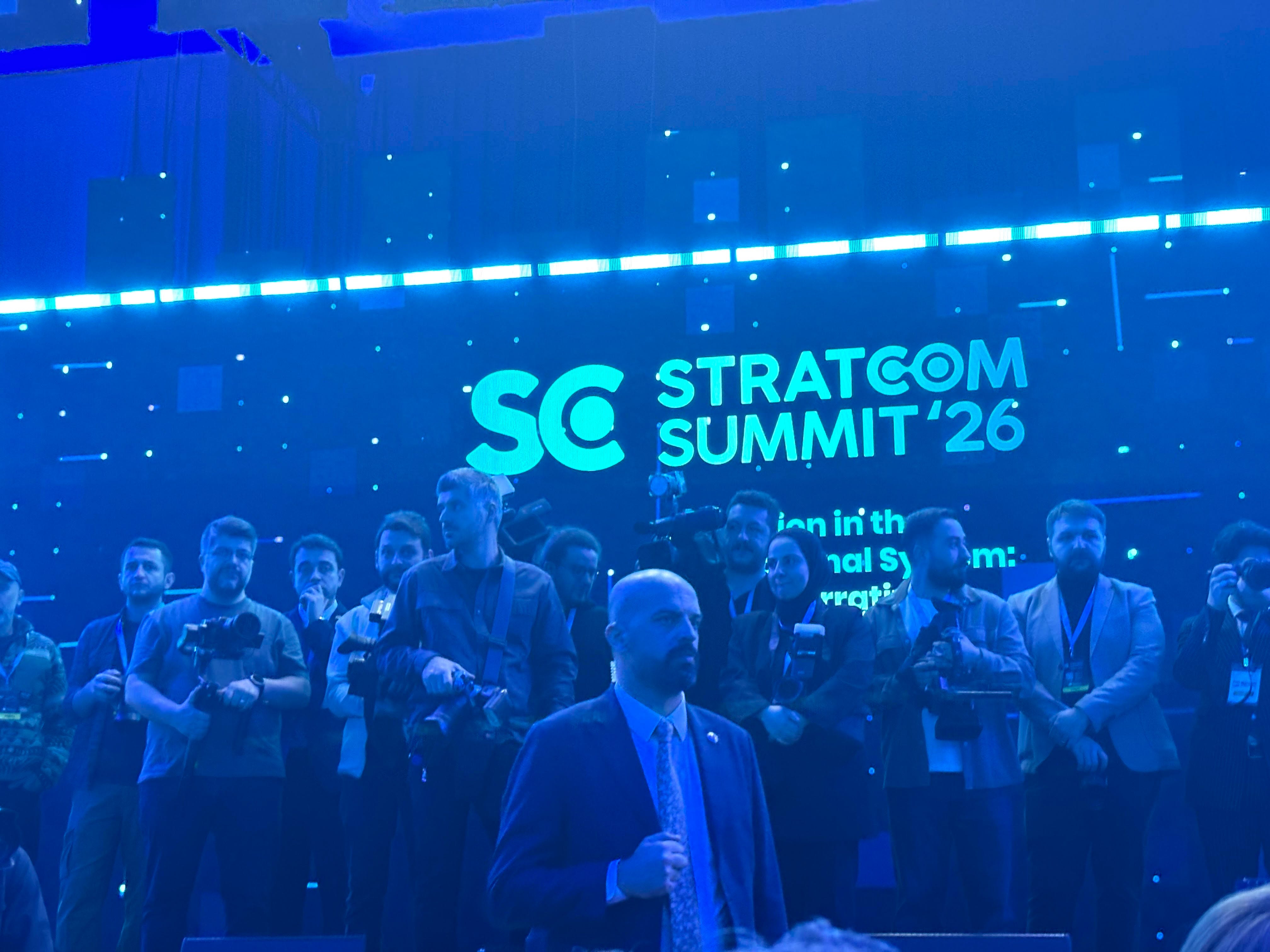
I went to a different summit in Istanbul this week called the Stratcom Summit, something put on by the government’s Directorate of Communications. It would have been useful for my piece in the Statesman. This year’s event was on the theme of “Disruption in the International System: Crises, Narratives, and the Search for Order”; unsurprisingly, much of the focus was on the war on Iran. There were familiar names and faces from diplomacy and regional governments (including a few from the Balkans) but the two most important speeches were from Turkish Foreign Minister Hakan Fidan and Director of the National Intelligence Agency (MIT) Ibrahim Kalin. I wanted to write up some thoughts from those speeches, though I will give more attention to Fidan’s since it was more topical.
First off, I hadn’t expected Fidan’s speech to be delivered in English, as most other officials gave theirs in Turkish. This meant that his words were definitely intended for a wide international audience. It was also a much more confident delivery than I’d seen from him before, and, I think, did what it had to do, which was project an image of an assertive Turkey amid regional war and crisis. The speech also had a bit of an “I-told-you-so” tone. Fidan repeatedly emphasized that the world–or perhaps just the West–is only just now catching up with what Turkey has been saying for years:
The present state of global governance is dysfunctional, paralyzed and unsustainable.
And this systemic disruption did not occur overnight.
It is the result of structural decay that Türkiye has systematically exposed for years.
President Recep Tayyip Erdoğan’s call for global justice and for the reform of international institutions was not a political slogan, it was a diagnosis.
A diagnosis many ignored until the crisis arrived at their own doorstep.
From the rostrum of the United Nations to countless multilateral platforms, we consistently sounded the alarm.
At the time, many preferred the illusion of their geopolitical comfort zones.
For years, as long as the cost of dysfunctional order was paid elsewhere, many were content with maintaining a self-serving status quo.
But today, that illusion has shattered.
Those who comfortably benefited from the unjust system are facing a reality as the crises finally touch their own shores.
I interpreted this mostly as a message for the West, and perhaps even a response to Canadian Prime Minister Mark Carney’s speech at Davos in January about the imperiled liberal order. At the time, many criticized Carney for the fact that he had only felt inspired to describe the deficiencies of that order when Western countries were finally the ones being threatened; you’ll recall that at this year’s Davos, the big fear was that the United States was about to annex Greenland. Critics pointed out that people like Carney hadn’t been too troubled about the hypocrisies of the liberal order when it was only non-Western countries that were subjected to violations of their sovereignty and occupation or annexation of their territory.
Something else I found noteworthy about Fidan’s speech was the conspicuous lack of criticism of the United States. In Fidan’s view, Israel is the aggressor, and Israel is responsible for the region’s malaise. From Turkey’s perspective, this careful sidestepping makes sense: US-Turkey relations have generally improved during Trump’s second term, and they probably don’t want to mess that up. The Trump administration has done several things that the Turkish government has wanted it to do: it lifted sanctions on Syria, pushed for the full integration of the Kurdish-led Syrian Democratic Forces (SDF) into the Syrian army, and reached a tentative deal to drop criminal charges against Turkey’s Halkbank over its business with Iranian entities.
But I also found it interesting because it somewhat mirrors a position increasingly held by many “restrainer” conservatives, realists, as well as some leftists in the United States. It’s a position that’s emerged from discussions about Israel and the United States that have only intensified since the start of the war on Iran. The debate centers around which country–Israel or the United States–is leading or instigating policy. Is Israel merely an “aircraft carrier” of the United States–a local, militarized outpost of the American empire that takes its orders directly from Washington? Or has the United States government been heavily influenced (and perhaps even captured) by Israeli interests and the powerful Israel lobby, who have exploited Trump’s vanity to achieve ends mostly beneficial to Israel but potentially detrimental to the United States? In other words, Fidan’s decision to sidestep criticism of Trump while criticizing Israel actually aligns with a growing tendency within American conservative thought.