


Dear readers, since I received a lot of new paid subscribers from my Lindsay Clancy essay about the state of psychiatry under MAHA/RFK Jr./Trump, I decided to continue in that vein this week with another post on thoughts inspired by the Clancy trial. The second half is behind a paywall, so consider becoming a paid subscriber today. It only costs $5 and I am grateful to each and every one of my subscribers for their support and encouragement.
During the early 1970s, dead infants started appearing in coin-operated lockers at train stations in Japan. Autopsies revealed that most of the babies had been suffocated or strangled to death. The number of “coin locker incidents” increased dramatically through the early years of the decade. The New York Times reported that in 1970, there were just two such cases. But by 1973, a dead infant was being found in a locker every ten days. Police investigations soon confirmed the truth behind the horrific discoveries: the infants were being murdered by their own mothers. The coin-operated locker infanticides have been attributed in part to the post-war decline in multigenerational households. In the post-war Japanese home, the father dedicated himself to the role of “company man” while women were expected to take care of the children. Japanese media described the apparent increase in maternal filicide–mothers who kill their own children–as emblematic of broader cultural changes. As scholar Alessandro Castellini has written, “major Japanese newspapers described the 1970s as the ‘era of the loss of motherhood’ and lamented the disappearance of a maternal instinct in women.”
These were the years immediately following the student protests of 1968. Out of that tumult emerged various movements of the New Left, including Japan’s own women’s liberation movement, ribu. As Castellini has written, the movement took a highly controversial approach to the subject of maternal filicide. Ribu depicted the phenomenon as a destructive but ultimately relatable and the natural result of the oppressive gendered expectations that women experienced in the patriarchal family. As one activist put it, “‘filicide [was] located at the climax of the circumstances in which all women [were] placed’.” Another ribu member asserted that “[b]etween the holy mother and the mother who kills her child there’s a paper-thin difference”. Maternal filicide was viewed as a rejection of women’s only socially sanctioned role. However, ribu activists did not view maternal filicide as something to be celebrated, but rather understood.
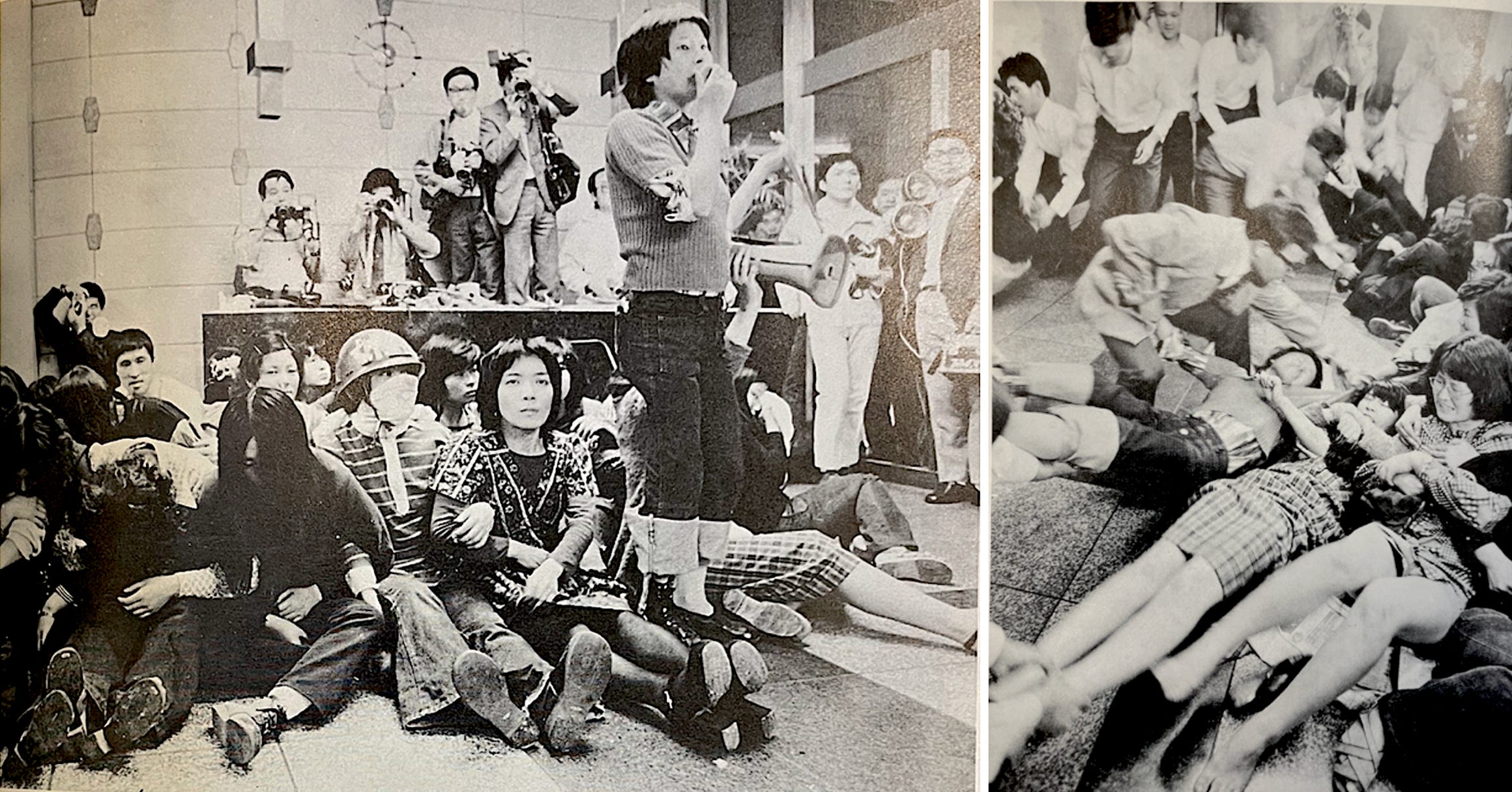
Some ribu groups engaged in street protests for the cause. As Castellini writes in his book Translating Maternal Violence: The Discursive Construction of Filicide in 1970s Japan:
On May 8, 1971, ribu cells in Tokyo organized a rally “in solidarity with women who kill their children”. Held on the occasion of Mother’s Day, this demonstration saw the participation of around 100 people, with women and children marching in the rain with marguerites in their hands…. Numerous demonstrations and meetings were held on that day in support of these criminalized mothers, triggering spontaneous forms of activism across the country such as the call to organize a rally in solidarity with filicidal mothers that was circulated in Hokkaido (Japan’s northernmost prefecture) by a ribu group called Metropolitan…
In their embrace of the criminal and despised, ribu’s approach to killer mothers has some parallels with the pro-pedophile activism that flourished in Germany during the same period. Both movements were New Left mutations that emerged in the defeated axis powers, and I do not think it’s a coincidence that the most extreme rejections of societal expectations were found there. Pedophile activism in Germany was rooted in the belief that the suppression of children’s sexuality within the patriarchal family led to authoritarianism. Pedophilia was therefore seen by some activists as the antidote to a new Hitler. Adherents of this belief found inspiration in the work of Austrian psychiatrist Wilhelm Reich and his book The Mass Psychology of Fascism (1933). “The authoritarian state gains an enormous interest in the authoritarian family: It becomes the factory in which the state’s structure and ideology are molded,” Reich wrote. Ribu likewise viewed the family system as the site of social discipline and control.
The Lindsay Clancy murder trial in America has produced a torrent of public sympathy for the accused, particularly among women. This has taken various forms and degrees, from the belief that Clancy was suffering from a terrifying episode of postpartum psychosis, to inane TikTok conspiracy theories that Lindsay’s husband Patrick really did it. Most luridly, female Clancy supporters have amassed outside the courthouse in Massachusetts for weeks now, dressed in their trademark pink. These displays have been described by the right-wing commentariat as an indictment of “our society”, of “fourth wave feminism”, of “Western women today” and of “modern women”. They have been seized upon by the online right to advance notions of societal decay and modern women’s supposed depravity. But as the example of ribu in 1970s Japan suggests, sympathy for filicidal mothers is nothing new. In fact, it’s built into the very foundations of the law in some Western countries. And while in the admittedly extreme example of ribu this impulse veered into apologia, at other moments in history, it was an expression of civilization and mercy.

Indeed, support for mothers who kill their children–and calls for leniency and mercy for them–dates back centuries.