

Dear readers, my apologies that posting here has been somewhat delayed. I am moving house–downsizing in anticipation of global economic crisis and skinny cow years. This has meant that my time has been far more scarce than usual. I’ll be returning to regular posting once I’m fully moved by the end of this week. As always, I am grateful for your patience and support.
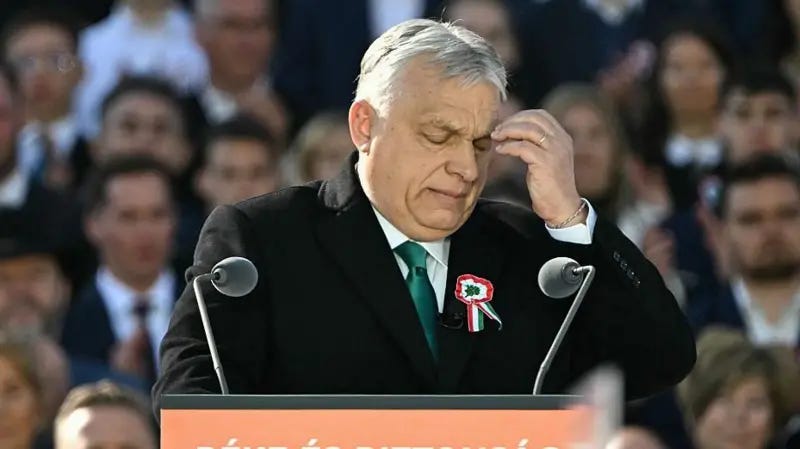
Viktor Orbán is out in Hungary. Europe’s enfant terrible for the last 16 years, the former liberal-turned-obstinate-pillar of the “conservative internationale” conceded defeat last night. He was ousted by Peter Magyar, an erstwhile ally who split from the outgoing Fidesz a few years ago. Magyar’s new Tisza Party (“Respect and Freedom Party”) is a generic center-right, pro-EU outfit, but managed to win 138 out of 199 seats in parliament; this means it secured the two-thirds majority necessary to change the constitution. Not since 2010, when Fidesz won a two-thirds majority in a vote described as the “revolution in the polling booth”, has a political party scored such a crushing victory in a Hungarian election.
Orbán’s defeat has implications beyond little Hungary. Taken together with Trump’s abysmal approval ratings and Italian Prime Minister Giorgia Meloni’s failed referendum last month, it hints at a global fatigue with right-wing populism–and the growing toxicity of the Trump “brand”. At the same time, a possibly related phenomenon: the “post-liberalism” trend of recent years appears to be falling out of fashion in intellectual circles. In Budapest, Orbán sought to cultivate his own incubator of conservative thought. A new network of think tanks, publications, and fellowships was created with the aim of nurturing thinkers on the right. In a sea of “globalist liberalism”, Hungary would serve as a bastion of conservative freedom, unencumbered by the hysterical dictates of Woke. But what did it do, really, other than give a faint intellectual veneer to complaints about Drag Queen Story Hour? The problem with it is that it was all negation. It lacked a positive message of its own. In this way, it was not unlike Russian propaganda, with which there is much overlap: it’s not that there aren’t major problems with Western liberalism, but rather that Putin–and Orbán, too, it would turn out–does not have an appealing counter offer. For now, it looks like Trump’s disastrous presidency is poised to inspire a liberal renaissance, and send much of the world running into the arms of globalist elites, begging to be taken back.
But back to Hungary. The campaign leading up to yesterday’s vote was an especially acrimonious one. It was marked by allegations of foreign interference, purported sabotage of a gas pipeline in Serbia, and leaks of private phone calls. But the insurgent Tisza’s overriding theme was anti-corruption. Indeed, Magyar ran a pretty standard “anti-corruption” campaign–a well-worn but effective tactic for unseating long-running regimes. It is an especially familiar formula for those of us who are students of Central and Eastern Europe. But what’s effective at winning elections has not always translated into effective governance. In fact, anti-corruption campaigns have a habit of becoming vehicles for corruption once their party takes office. The fall of Orbán ally Nikola Gruevski in North Macedonia was one of the most glaring examples. Prime Minister Gruevski was brought down by the center-left SDSM led by Zoran Zaev, who promised an end to corruption. The country even opened a special office for prosecuting corruption cases in 2015, and its female prosecutors received glowing write ups in Western media that likened them to a crime-fighting “Charlie’s Angels”. Lo and behold, once in power, SDSM ended up being spectacularly corrupt themselves; even “Charlie’s Angels” were eventually implicated in graft. And who could forget Serbian leader Aleksandar Vučić’s widely heralded anti-corruption crusade, on which his party rode to power in 2012 and which defined his earliest years in office? To think that Vučić could ever present himself as an earnest voice against corruption is laughable today.
This is not to rain on anyone’s parade. I, too, feel a sense of relief that Orbán lost. But the implications are many, and I have not yet processed them all. I am acutely aware, for instance, that this is very bad news for Bosnian Serb leader Milorad Dodik and President Vučić. Orbán was their champion, their bridge to Trump, their big Magyar brother across the border who could throw his weight around in the international arena more than they could. Who does Dodik have now? And what about Vučić? In Europe at least, they are alone. Of particular interest is the fate of the sale of NIS–the Petroleum Industry of Serbia, majority-owned by Gazprom–to the Hungarian multinational oil and gas company, MOL. The entire deal seemingly hinged on Orbán’s unique ability to act as a bridge between Washington, which has sanctioned NIS, and Russia, which is selling its majority share of it. With Orbán gone, the status of that deal is unclear.
But perhaps today is not the day to worry about all of that. Perhaps today is just a day for remembering that things can change.
"But what did it do, really, other than give a faint intellectual veneer to complaints about Drag Queen Story Hour? The problem with it is that it was all negation." What a set of sentences - I do love the way you write. Really enjoyed the Baffler piece also.