

Dear readers, this is another free post for all, but I will likely need to start paywalling more of them. That said, I am grateful to all of my subscribers, both free and paid, and I appreciate each and every person who reads, likes, and shares my work. If you haven’t already, subscribe today and never miss a thing.
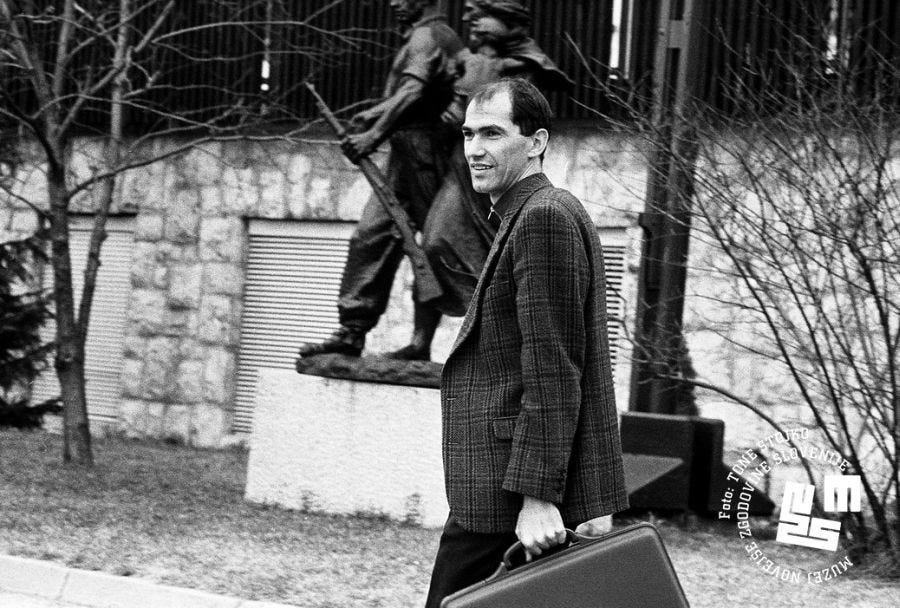
Tomorrow, right-wing svengali Janez Janša will become prime minister of Slovenia for the fourth time. Janša has been a stubborn barnacle on Slovenian politics since 1989, and served as Minister of Defense during the brief war with Yugoslavia in 1991. His return to power, engineered in part by Israel, has sent a collective groan through certain swaths of the tiny Alpine country, whose post-independence politics have been dominated by the man. There is no one more furious about the entire state of affairs than members of the outgoing center-left coalition, who appear to be making good use of their final hours in power to convey some rather strong messages.
The most apparently dramatic signal today was directed at Israel. Readers who’ve been following my coverage of the “Slovenia affair” either here or in Le Monde diplomatique will be aware that Israeli intelligence officers have meddled extensively in the internal affairs of the country in recent months, particularly in the March parliamentary elections. Earlier today, the government decided to prevent a plane flown by the Israeli charter company Israir from landing at the airport in Ljubljana. The aircraft was instead forced to divert to Croatia. Predictably, the move drew immediate condemnation from Israir CEO Uri Sirkis, who described the decision as “political” and rooted in the Slovenian government’s “clear opposition to the policies and direction pursued by Israel.” The Slovenian government maintains that the plane did not have clearance to land. Last-chance show of defiance or mere coincidence, the decision and the irate response it provoked in Tel Aviv were yet another expression of the outsized role Israel now plays in Slovenia’s affairs.
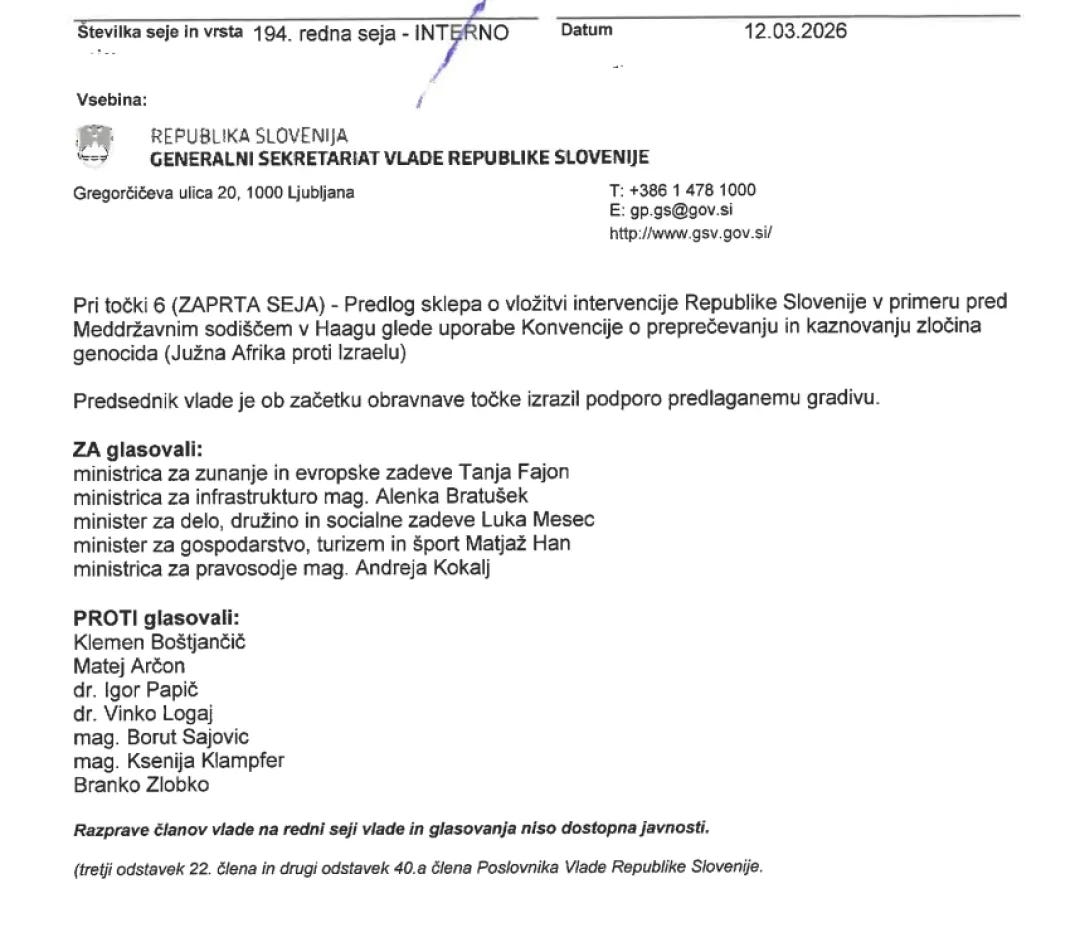
But there were also messages about Israeli interference in Slovenia that were conveyed by individual factions within the outgoing coalition. Readers will be aware that the focus of much of my reporting on Israeli meddling in Slovenia has concerned the government’s surprising decision not to join South Africa’s genocide case against Israel at the International Court of Justice (ICJ). The announcement that Slovenia had reversed course and would not join the case as expected was made just days before the election. Much of my own research involved trying to understand how this decision had been reached, what kinds of pressure Israel had exerted, and which Slovenian ministers had ultimately caved in and decided against joining. However, much critical information remained out of view of the public at the time of my investigation: the vote on whether to join the ICJ genocide case was made in a closed government session on March 12th, meaning no one, including very well-placed journalists and relative insiders in Slovenia, had access to concrete knowledge about how individual ministers voted. The information was classified as “secret” and its disclosure labelled a threat to state interests.
Today, that all changed. In a decision reportedly taken by the Ministry of Foreign Affairs, information detailing which ministers voted to join the lawsuit has been made public for the first time. There are political reasons for this: the outgoing MFA is Tanja Fajon, who has been especially vocal in her support of Palestine, as has her party, the Social Democrats. And as the newly released document detailing the vote makes clear, it was Svoboda (“Freedom”), the liberal party of outgoing Prime Minister Robert Golob, that was ultimately against joining the ICJ genocide case. Indeed, only one Svoboda minister voted in favor of doing so. Meanwhile, Fajon’s Social Democrats all voted “yes” to Slovenia joining the ICJ genocide case. Perhaps most disappointing of all were the two ministers from Levica (“the Left”) out of three who were absent for the vote. Levica is the Slovenian party that purports to be the furthest left and also fashions itself the most pro-Palestine. According to Levica supporters, one of the party’s ministers who was supposed to vote was on a trip during the session, while the other was present but stepped outside into the hall to talk on the phone and ended up missing the vote entirely. You could hardly write a more comically damning account of leftist negligence.
And just like that, the center-left government of Slovenia exits stage left. Janša is back, Israel is happy, and Slovenia can go back to being a pretty postcard country where nothing ever happens.
Interesting to learn of Israel's reach in the world...
Now I'm reading another Israeli firm, BlackCore, was accused of meddling in Scotland, NYC, Angola, and Togo, according to the French... truly our most honored and Special Ally, the great nation of Israel, is just really talented and sought-after! No complaints here!