

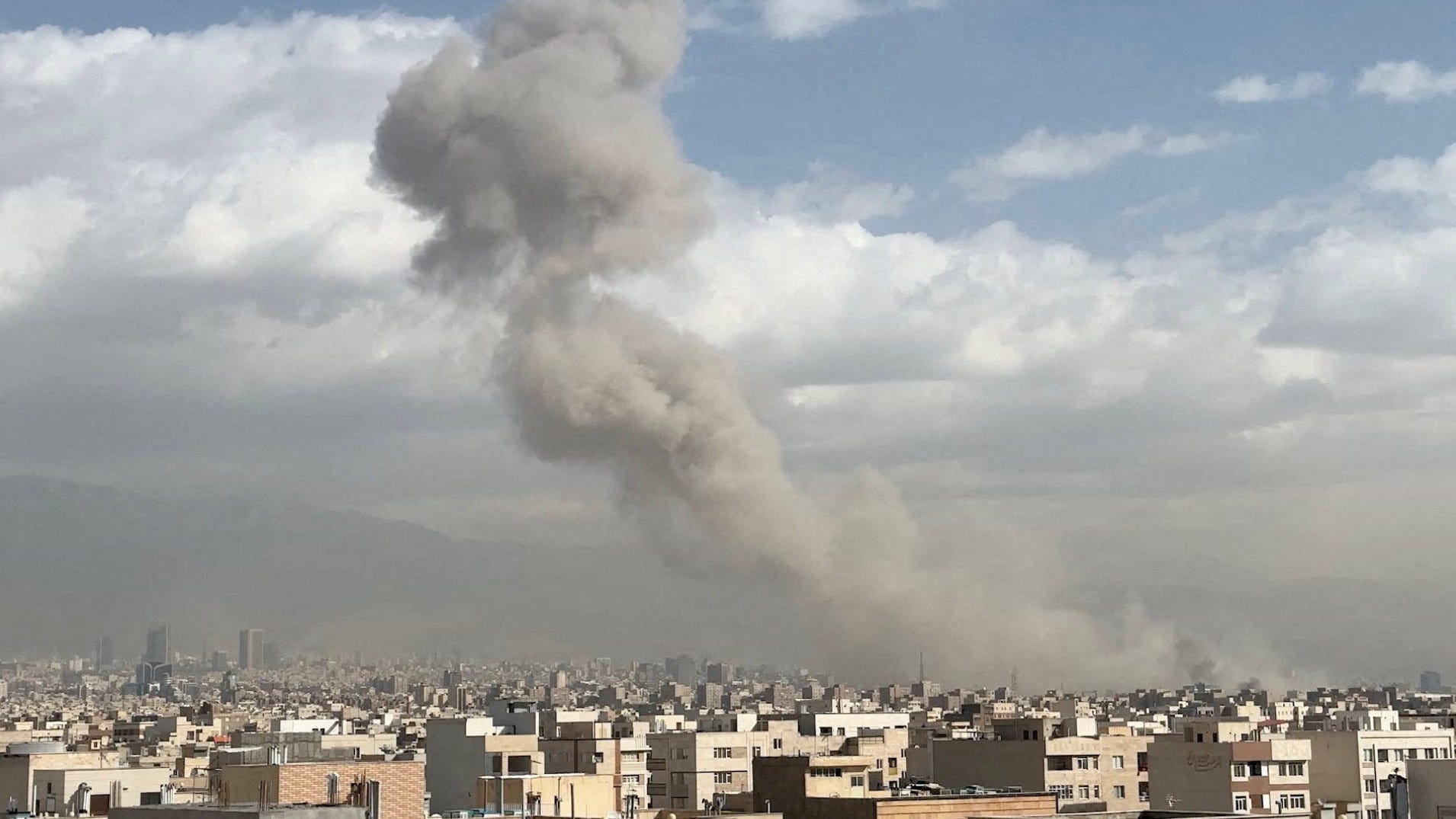
Beginning at around 9:40 am local time yesterday, while most Americans were fast asleep, the US and Israel launched a new war on Iran. No clear objective has been provided to the American public. In a speech announcing the attack, President Trump offered a list of grievances as justification, many of them ancient history by American standards: the Iranian hostage crisis (1980), the Beirut barracks bombing (1983), and the Iraq War (2003). It reminded me a bit of Putin’s speech on February 21, 2022, in which he set forth his own list of grievances about Ukraine drawn from Russia’s much longer, deeper historical memory: territorial arrangements from the 16th century, the October Revolution of 1917, and Khrushchev’s 1954 transfer of Crimea to Ukraine, among other excuses proffered for the “Special Military Operation”.
The two speeches made me think about Joseph Brodsky’s essay, “Blood, Lies and the Trigger of History” published during the Bosnian War in 1993:
Evocations of history here are bare nonsense. Whenever one pulls the trigger in order to rectify history’s mistake, one lies. For history makes no mistakes, since it has no purpose. One always pulls the trigger out of self-interest and quotes history to avoid responsibility or pangs of conscience. No man possesses sufficient retrospective ability to justify his deeds -- murder especially -- in extemporaneous categories, least of all a head of state.
We have alternately heard that this war is about destroying whatever remains of Iran’s nuclear program (which we were already told was “obliterated” in the last US and Israeli attack on Iran in June), and that it is about regime change. Indeed, the Supreme Leader, Ali Khamenei, was killed last night, but that does not mean that the government is about to fall. The usual justifications about human rights have been rolled out by some peripheral figures but have never sounded less convincing or more selective. Perhaps the clear lack of objective conceals a darker agenda: many experts believe that Israel would be satisfied with a ruined country fractured by civil war. A country mired in chaos and sectarian bloodshed would pose no threat to Israel. It is a tactic Israel has tried in Syria with some success, if you can call it that. What’s remarkable is that this war on Iran, which has already killed at least three Americans, has no discernible strategic benefit for the United States.
I posted an observation on X yesterday that generated a lot of talk and hate. I wrote that I’d seen a lot of people complaining that there was no propaganda campaign in the lead-up to this war, no effort to convince the American public that we were at imminent risk. There was a rather haphazard, tacked-on attempt by Steve Witkoff to advance the idea that Iran was a “week away” from being able to build a nuclear bomb, but this messaging came late and contradicted the administration’s prior reports about an obliterated nuclear program. Indeed, the Trump administration’s foreign policy is warned over boomer neoconservativism, but unlike the neocons before him, he hadn’t tried to give the war on Iran a clearly defined objective or coherent propaganda narrative. On X, I suggested that this was because he no longer has to: there have been no mass anti-war protests like the kind that accompanied the runup to the invasion of Iraq. Several people objected to this, claiming that protests in 2003 only started after the war began, but this, as anyone who participated in those protests remembers, is false: there were massive protests against the war before even a single missile was launched. I suggested that the reason the government can count on our relative inaction is that the American people are largely pacified by technology, utterly stupefied and numb from online shopping and personalized algorithms mainlining a steady stream of mind-melting short-form video content to each individual. Of course, there are still pockets of virulent opposition on college campuses and in the streets which I don’t wish to diminish, but in wars past, protest was truly a mass phenomenon. And I do think that we are more atomized and more pacified today. Back in 2003, we hadn’t yet completely retreated into our screens.
However, I don’t think that’s entirely right. Or rather, I think it’s part of the story, but not the whole thing. There is a parallel process at play, which has something to do with autocratization (yes, I said it), a trend observable in liberal democracies as well as authoritarian regimes. For years, theorists of “authoritarian neoliberalism” have written that after the 2008 financial crisis, leaders in capitalist countries shifted “towards more undemocratic and coercive forms of neoliberalism”. As political economist Ian Bruff has written, authoritarian neoliberalism can involve direct repression, surveillance, and coercion against dissent, but it means more than “the exercise of brute coercive force”; in fact, it also manifests in attempts to “insulate certain policies and institutional practices from social and political dissent”. Indeed, the planned invasion of Iraq was preceded by months of political discussion, hearings and congressional resolutions, as well as the aforementioned anti-war demonstrations. The point isn’t that any of that was effective at stopping the war; the point is that it was still considered necessary. Now, the government doesn’t even feel like it needs to come up with an elaborate pretext, phony intelligence, or the theatre of congressional hearings that would lend the war a faint veneer of quasi-democratic legitimacy. Trump just does things. Indeed, his acts of aggressive unilateralism are often marked by surprise, which requires keeping the public in the dark. This means there is no pantomime of democratic buy-in, no fake “procedure”, and no sustained, coherent propaganda campaign.
Of course, Trump is the most extreme, “mask-off” version of this tendency, but I do feel that much of the West is developing in this same general direction: democracies are getting less democratic, as politicians feel less and less that they need to seek the consent of the governed–or even just the appearance of consent–before undertaking wildly unpopular action. We are in an era of governance by “you can just do things”, wherein the messiness of liberal democracy looks more and more like an obstacle to keeping up with our rivals.
Dovetailing with those two points I think it’s necessary to recognize that this war and the Maduro kidnapping bear no resemblance to that of Iraq or Ukraine. Seems quite far fetched at this point that conventional US ground troops will set foot in Iran. Completely postmodern warfare to compliment our postmodern politics