

It’s Christmas, which means it’s a fantastic time to buy yourself or someone else a very last minute monthly subscription to my Substack. At just $5, it costs about the same as a single cup of coffee.
This week, I’m continuing with my experiment in adding video interviews to this newsletter. I may keep doing it or I may not–it really depends on how I feel. As ever, I'm happy to hear feedback about what you prefer.
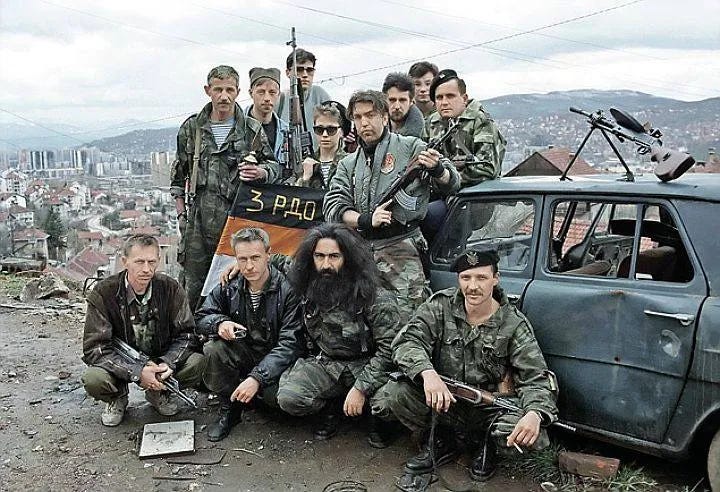
For this week’s interview, I finally got to talk to John Lechner, a great writer, journalist and exceptionally talented linguist who wrote Death is Our Business: Russian Mercenaries and the New Era of Private Warfare, one of my favorite books of the year. John and I spoke about Death is Our Business, with a special emphasis on the Balkans, Ukraine and Syria. We also talked about what motivates mercenaries and mujahideen to go and fight, the afterlives of the Balkan Wars of the 1990s in Ukraine and Syria, and the idea that “the Yugoslav Wars never ended, they just entered into global circulation”. We also revisit the battle between Wagner and the US military in Syria in 2018 and Wagner leader Yevgeny Prighozin’s love of Gramsci’s theory of cultural hegemony.
You can follow John on X.
I'm finally catching up on the video interviews and really enjoyed both! I remember listening to John on both American Prestige and Radio War Nerd; I already had his book on my list to get but now I've moved it to the top!
2 home runs out of two with your video "experiment." Notwithstanding John's obvious extraordinary ability as a linguist, researcher and narrative architect - his build-up to and retelling of the Conoco gas plant story was a personal highlight. His Crimea-top-down-Donbass-ground-up comparison reminded me of the guys in clean combat fatigues wearing shooting-sunglasses, carrying rifle-cases on the Moscow Metro in 2014... usually alone and just passing through.... and how that reminded me of reporter friends emphasising the $ in Syria's war.. which reminded me of friends in Croatia telling war-time frontline-deal stories and then to home: Ireland, territory, nationalism, the republican movement's reliance on cross-border "trade" to generate cash, and indeed the subsequent wider slide (as elsewhere in Western Europe) of that identity politics into a harder, rightist, rump.
In short, Lily, work that is fascinating, worthy and of unusual quality. (Any time there's a "From what we can tell from letters...." you know you're in NewBooksNetwork territory.)
Truth: the skeptic in me detected pauses in John's storytelling at junctures where I felt he kinda stared into the "off-message abyss," though perhaps that particular sensitivity was piqued by his fascinating (and imho fundamentally important) account of how an Africa book eventually found its place on the geopolitics middle aisle (top shelf!);). I will buy the book, I congratulate John, and thank you.
Happy new year.