

I just arrived in Florida after something like 30 hours of travel, meaning I am jet-lagged and delirious. Therefore, please forgive any lapses in grammatical logic or egregious spelling errors.
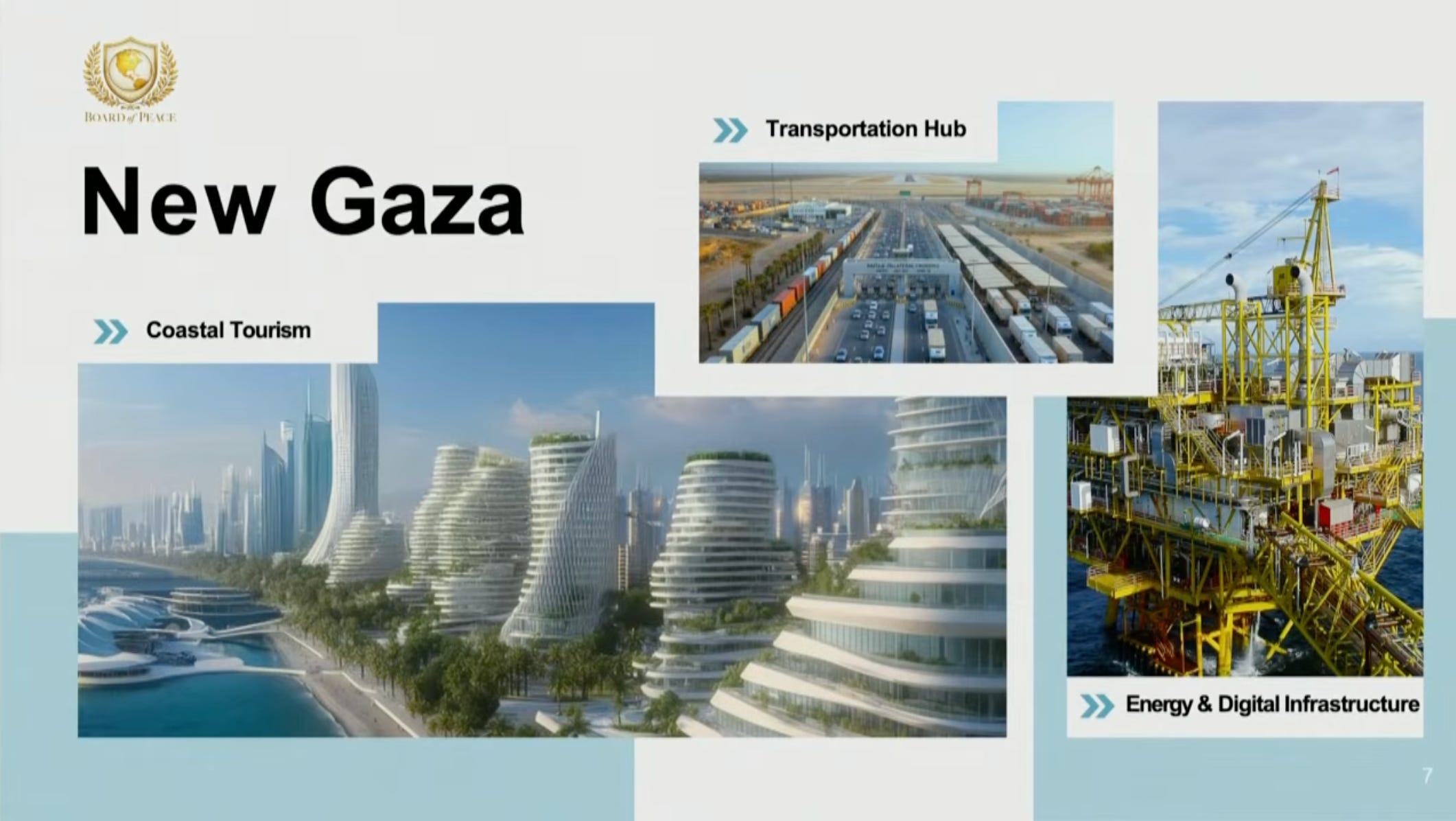
Trump just unveiled his big Board of Peace at Davos, with a signing ceremony attended by representatives of foreign governments formalizing the body’s international status. On paper at least, the Board of Peace was supposed to be about administering peace in Gaza and rebuilding the ruined strip. When it was announced last year, it was immediately savaged as a naked colonialist power grab; indeed, its many critics noted that it would simply reproduce the occupation in a new, glitzy form. But watching Trump’s ceremony at Davos, it was clear that the Board of Peace is about more than just Gaza. For Trump and others in his orbit, the board is about flaunting the impotence of “globalist” institutions like the UN. The board’s establishment is yet another crude demonstration of Trumpian dominance over the liberal post-war order and the institutions and logic upon which it was built. Though Trump noted in Davos that the UN “has tremendous potential”, he also stressed yet again that he’d solved eight wars without the UN: in other words, Trump claims that he had succeeded where the UN had failed. And yet, Trump also struck a more measured tone today. During his speech, he said the Board of Peace would work with the UN. Still, even if the Board of Peace was not established with the expressed goal of destroying the UN, it was also clear that it had been founded in part to circumvent it. Today’s event also made clear that Trump and son-in-law Jared Kushner view Gaza as a business opportunity, and are trying to lure risk-friendly investors into helping build a futuristic Gulf-style mega-project atop the world’s largest crime scene.
I was struck by the number of familiar faces onstage, including among those playing leading roles. Nikolay Mladenov, who has been both foreign and defense minister of Bulgaria, will be high representative for Gaza, meaning he will serve as the link between the Board of Peace and the newly established National Committee for the Administration of Gaza, a technocratic committee led by former Palestinian Authority deputy minister Ali Shaath. Originally, this role was supposed to go to none other than dark prince Tony Blair. After much backlash from Arab partners, for whom Blair is radioactive owing to his leading role in destroying Iraq, Mladenov was named to the position instead.
Watching the event streamed live from Davos, I remembered Mladenov from an event in London many years ago–a foreign ministers’ debate held with Serbia’s then-foreign minister Vuk Jeremić. I recall being very impressed with Mladenov at the time. Compared to Jeremić, who was playing the role of obstinate cowboy nationalist opposed to anything that deviated from the hardline Serbian position on Kosovo, Mladenov seemed very fair and, well, diplomatic. He was sympathetic to Serbia’s position but uncompromising on Bulgaria’s recognition of Kosovo’s sovereignty. Remembering that event all those years ago, I could understand why he’d been chosen for his current role.
And yet, there is more than diplomatic skill at play in this choice. These days, Mladenov works as the director-general of Anwar Gargash Diplomatic Academy in Abu Dhabi and is a proponent of the Abraham Accords. Unsurprisingly then, this means he is very much onboard with the Trump administration’s “Israel First” policy of making Arab states’ normalization with Israel the cornerstone of regional security. Al-Jazeera has characterized Mladenov’s embrace of the Emirati-Israeli position as a “subtle but significant realignment”. In his role as the top UN envoy to the Israeli-Palestinian conflict, he was viewed positively by all sides, seen as a truly neutral actor. In 2021, the New York Times quoted several people representing various sides of the conflict, all saying positive things about Mladenov:
“A very honest broker,” Rami Hamdallah, a former prime minister of the Palestinian Authority, called him.
“I personally depended on him,” said Moshe Kahlon, a former Israeli finance minister.
“A man of integrity,” said Jason Greenblatt, the Trump administration’s former Middle East envoy.
“We are proud to have known him,” said Khalil al-Hayya, the deputy Hamas leader in Gaza.
But with a new regional realignment well underway–the UAE and Israel appear to be coalescing into a bloc, while Saudi Arabia, Turkey and Egypt look to be forming another–Mladenov begins to seem less like a neutral arbiter and more of a proponent for the Israeli side.
However, in 2021 he told the New York Times that he approached the region with the caution and sensitivity of someone who came from a part of the world burdened with similar issues:
“I come from the Balkans,” he said. “We’ve changed borders. We’ve fought over holy places, languages, churches. We’ve exchanged populations, for 100 years, if not more. And when you carry that baggage, it does help you see things a bit differently. This is not a conflict where you can come in and just draw a line. It’s emotional.”
“I know from my own experience that when the quote-unquote foreigners come and tell you what to do, you just shut them off. You’re like, ‘Thank you very much,’” he added. “You can’t preach to these guys. Remember, they’ve been it at it for half a century.”
Among the other leaders who are on the the Board of Peace and participated in today’s signing ceremony were Kosovo’s President Vjosa Osmani (the only woman on the board), Armenian Prime Minister Nikol Pashinyan, Azerbaijan’s President Ilham Aliyev, Kazakhstan’s President Kassym-Jomart Tokayev, Hungary’s Viktor Orban, Turkey’s Foreign Minister Hakan Fidan, Prime Minister of Bulgaria Rosen Zhelyazkov, Uzbekistan’s President Shavkat Mirziyoyev, and Mongolian Prime Minister Gombojavyn Zandanshatar.
Both the inclusions and omissions here are significant.